
What are the 5 characteristics of a growth mindset?
Shifting your mindset from fixed to growth isn’t just a poorly understood psychological concept. It relies on specific, measurable behaviors, the same ones psychologist Carol Dweck identified through decades of research on the subject.
What Are the 5 Characteristics of a Growth Mindset?
The 5 characteristics of a growth mindset are:
- Embracing Challenges: Instead of avoiding difficult tasks, people with a growth mindset treat challenges as the necessary way to become better at something.
- Valuing Effort: Hard work doesn’t mean something is wrong with your ability. It’s seen as exactly how mastery gets built in the first place.
- Learning from Setbacks: A failed attempt isn’t a cue to quit. It provides useful data to adjust your strategy. You can use this feedback to keep moving forward.
- Welcoming Feedback: Growth-minded individuals embrace constructive criticism as essential data for improvement rather than a personal attack, making it incredibly important to implement instead of brushing off.
- Finding Inspiration in Others: Rather than feeling intimidated, growth minded people view the achievements of others as motivation and proof of what is possible, using other people’s wins as fuel instead of a source of insecurity.
But simply memorizing these five growth mindset traits won’t automatically upgrade your career or your habits. To actually put them to work, you need to identify how each one shows up in real life, along with the steps you can take to start applying them today.
1. Embracing Challenges
Growth-minded individuals do not shy away from friction. Instead of avoiding difficult tasks, they actively seek them out because they understand that challenges are the necessary mechanism for improvement. A fixed mindset avoids the unknown to protect the ego; a growth mindset leans into the unknown to build capacity.
Real-World Example: Imagine you are offered the chance to lead a high-stakes presentation using software you have never touched. A fixed mindset declines the offer to avoid looking foolish. A growth mindset accepts the project, knowing the intense pressure will force rapid skill acquisition.
Actionable Step: Identify one task you have been avoiding this week because it feels “too hard” or unfamiliar. Break it down into three micro-steps and complete just the first step today.
2. Valuing Effort
Society often idolizes effortless success, but true mastery requires sustained effort. Having a growth mindset means realizing that hard work does not indicate a lack of natural talent. Effort is exactly how talent is forged in the first place.
Real-World Example: Think about writing a complex business proposal or editing a piece of content. The first draft is rarely good. Spending an extra three hours refining the work is not a sign of incompetence, it’s the standard protocol for producing high-quality output.
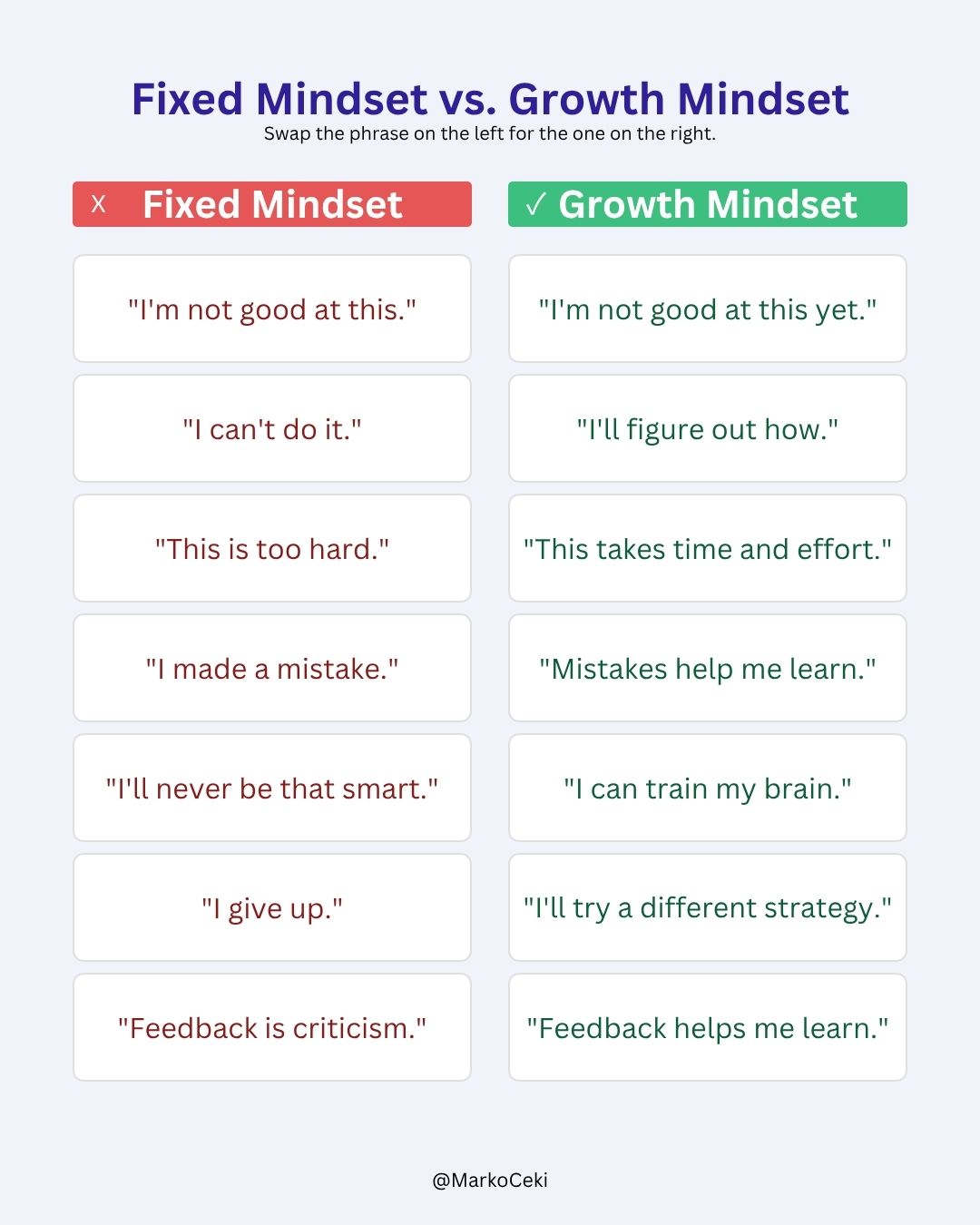
Actionable Step: Audit your internal dialogue. The next time you hit a wall and feel frustrated, catch yourself. Replace the thought, “I am not good at this,” with, “This friction is actively building my capabilities.”
3. Learning from Setbacks
A failed attempt is never a cue to quit. When a project falls flat, a fixed mindset views the failure as a permanent identity. A growth mindset views the failure as a temporary data acquisition phase. Setbacks provide high-value information you can use to adjust your strategy.
Real-World Example: You launch a new product or service, and the initial sales fall completely flat. Instead of scrapping the entire business plan, you dive into the metrics. You identify exactly where potential clients dropped off, adjust your copywriting, and relaunch with a tighter strategy.
Actionable Step: Conduct a blameless post-mortem on a recent setback. Write down three objective facts about what went wrong and identify one specific adjustment you will make for your next attempt.
4. Welcoming Feedback
Growth requires external perspective. Constructive criticism is essential fuel for improvement, rather than a personal attack to be deflected. If you want to optimize your performance, you must separate your self-worth from the work you produce.
Real-World Example: A trusted client or mentor tears apart a project you spent weeks building. Instead of getting defensive and justifying your choices, you ask clarifying questions to understand their perspective. You use their insight to rebuild a much stronger final product.
Actionable Step: Proactively reach out to a respected peer or mentor this week. Ask them for one piece of brutal, constructive feedback on your recent work. Listen completely without defending yourself, and thank them for their honesty.
5. Finding Inspiration in Others
It is easy to feel intimidated when surrounded by high performers. However, growth-minded people do not view the success of others as a threat. They view the achievements of their peers as tangible proof of what is possible, using that success as a blueprint rather than a source of insecurity.
Real-World Example: A competitor reaches a massive milestone you are currently striving for. Instead of writing off their success as “luck,” you reverse-engineer their process. You study their trajectory to see what actionable habits you can apply to your own systems.
Actionable Step: Identify someone who has already achieved a major goal you are working toward. Study their daily routines or business strategies, and implement one of their proven habits into your own workflow tomorrow morning.
Developing a growth mindset is not a one-time thing; it’s a daily practice. By consistently applying these five characteristics, you stop running away from friction and start using it as the exact mechanism to reach your full potential.