How to meditate for beginners at home
Does your mind feel like it never stops racing? Maybe you’ve tried meditation before but wondered if you were doing it wrong.
In this article, you’ll learn how to meditate in 5 simple steps. Whether you’re meditating for the first time or looking for simple mindfulness techniques you can actually stick with, these steps will help you build a meditation habit that lasts.
If you prefer visual learning, click play on the video below 👇
I Used to Think I Was Bad at Meditation
The first time I tried to meditate back in 2020, I think I lasted about ten seconds.
I sat down, crossed my legs, closed my eyes…and my brain would not stop talking.
I was 24 years old, trying to grow my first business, and I felt overwhelmed. The second I became quiet, my mind jumped from my to-do list to things that might happen in the future to what I should eat for lunch.
I got frustrated and gave up.
I thought I just wasn’t someone who could meditate.
More importantly, I thought the goal of meditation was to completely clear my mind and stop thinking.
That was the biggest thing I misunderstood about meditation.
Your mind wandering does not mean you are bad at meditation.
In fact, noticing that your mind wandered and bringing your attention back is one of the most important parts of the practice.
That changed the way I looked at meditation completely.
Instead of trying to force my brain to be quiet, I started practicing something much simpler:
Notice. Return. Repeat.
Let’s look at why that matters.
What Meditation Is Actually Training
Your brain is built to think.
It constantly thinks about the past, plans for the future, and jumps from one random thought to another.
Scientists call the system behind this mind-wandering the Default Mode Network (DMN). You may find it helpful to think of it as your brain’s internal autopilot. It is the background program that automatically kicks in the moment you stop focusing on a specific task.
That is why you might sit down to meditate and suddenly find yourself remembering something embarrassing from five years ago, worrying about tomorrow, drafting an email, or wondering what you’re having for dinner.
That is why you might sit down to meditate and suddenly start thinking about:
- Something embarrassing you did in the past
- An important email you need to send
- What you’re craving for lunch/dinner
- Why a text you sent was read but no reply
None of this means you’re doing meditation wrong.
During a simple breathing meditation, you practice putting your attention on one thing, such as your breath.
Eventually, your mind wanders.
Then something important happens:
You notice it.
Once you notice that you got distracted, you gently bring your attention back to your breath.
That is the practice.
You can think of each return as a small repetition for your attention, similar to doing a repetition at the gym.
Over time, meditation may help train brain systems involved in attention, awareness, and emotional control.
But you do not need to understand neuroscience to start meditating.
You just need to practice noticing where your attention goes and bringing it back.
The S.P.A.C.E. Framework: How to Meditate in 5 Simple Steps
You do not need to meditate for an hour.
You do not need a perfectly quiet room.
And you definitely do not need to sit on top of a mountain.
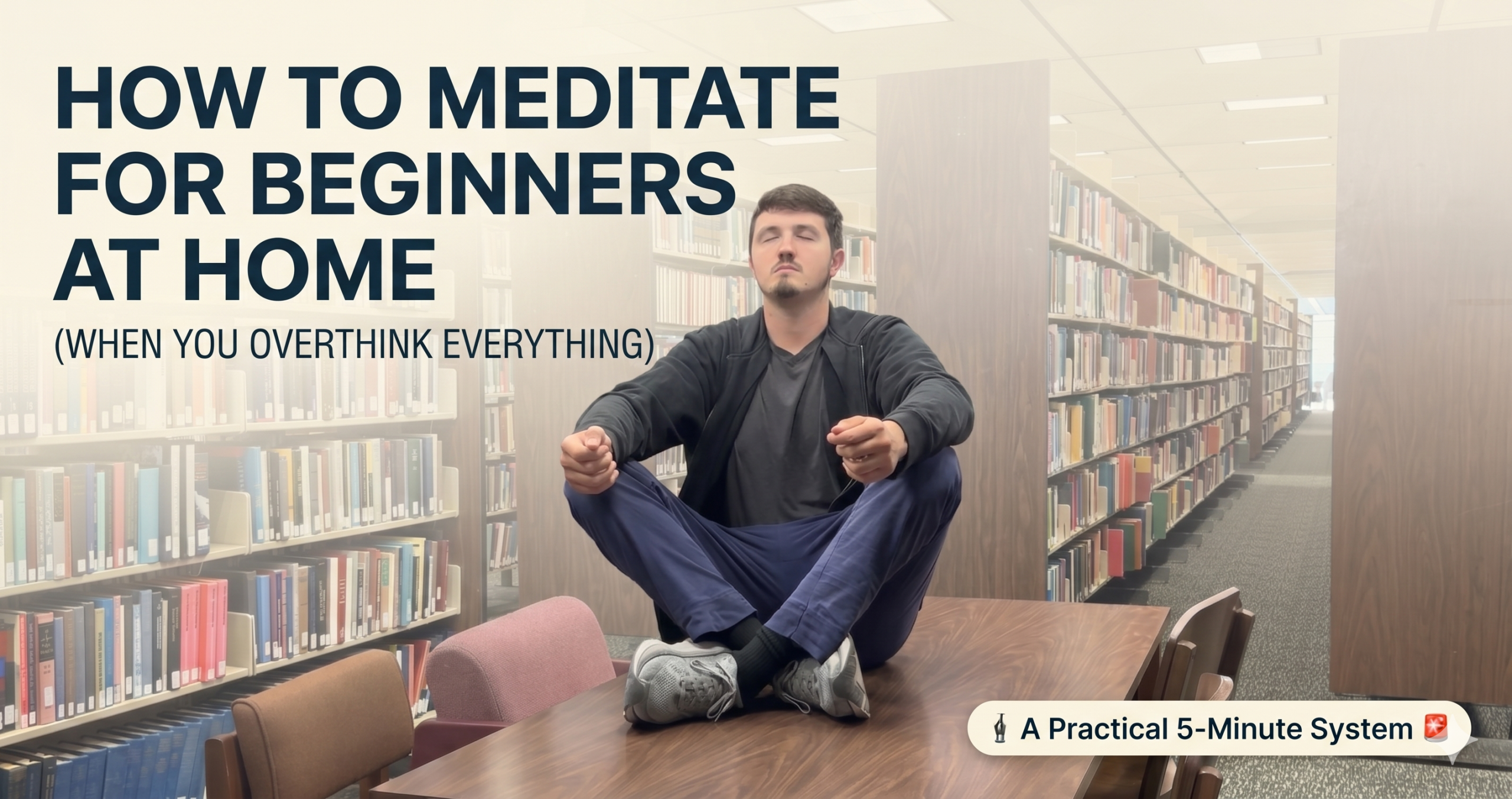
If you are learning how to meditate at home, start with just five minutes.
Here is the simple S.P.A.C.E. framework I recommend for beginners.
1. Sit Simply — S
Forget about finding the “perfect” meditation position.
No need to sit cross-legged on the floor if that is uncomfortable for you.
You can sit:
- On a chair
- On your couch
- On a meditation cushion
- On the edge of your bed
Try to sit upright without making your body stiff.
Let your shoulders relax and place your hands wherever they feel comfortable.
The goal is simple:
Be comfortable enough to stay still, but alert enough that you do not fall asleep.
2. Pause and Set a Timer — P
Set a timer for five minutes.
Using a timer makes meditation much easier because you do not have to keep wondering:
“How long has it been?”
“Am I almost done?”
“Should I check the time?”
The timer takes care of that for you.
For these five minutes, give yourself permission to do nothing else.
You don’t need to solve any problems.
There’s no need to check your phone.
No need to be productive.
Just sit.
3. Acknowledge — A
Close your eyes if that feels comfortable. You can also keep them slightly open and look gently toward the floor.
Now choose something to focus on.
Your breath is an easy place to start.
Notice what breathing actually feels like.
You might feel:
- Air moving through your nose
- Your chest rising and falling
- Your stomach moving as you breathe
Pick one of those feelings and rest your attention there.
Sooner or later, a thought will appear.
That is completely normal.
You do not need to fight the thought or try to make it disappear.
Simply notice that it is there.
Then return your attention to your breath.
4. Come Back — C
At some point, you will completely forget that you are meditating.
You might suddenly realize you have spent the last 30 seconds thinking about work, dinner, your phone, or an awkward conversation from three years ago.
Good.
Seriously.
That moment when you realize your mind wandered is part of the meditation.
You noticed that your attention had moved somewhere else.
Now gently bring it back to your breath.
Your mind wanders.
Just notice it and then come back.
Then it happens again.
This cycle is not a mistake.
That cycle is the practice.
Don’t get angry with yourself when your mind wanders. You are not trying to win a fight against your thoughts.
Just notice what happened and come back.
5. Expand Your Awareness — E
When your timer goes off, do not immediately grab your phone and rush to the next thing.
Take a few seconds first.
Notice your breathing.
Feel your body sitting in the chair.
Listen to the sounds around you.
Notice the light in the room.
Then slowly open your eyes if they were closed.
No need to feel completely calm.
You do not need to feel different at all.
The goal of meditation is not to create a certain feeling every time you sit down.
The important thing is that you practiced paying attention.
And you can practice again tomorrow.
The Guided Meditation App I Use
You do not need an app to meditate.
A chair, five minutes, and your breath are enough to get started.
But guided meditation can make the process easier when you are a beginner.
The app I personally use is Waking Up.
I’ve tried several meditation apps over the years, but Waking Up is the one I’ve continued using consistently.
It helped me understand meditation beyond simply “sit down and try not to think.”
The app includes guided meditations along with lessons that explain what you are practicing and why.
That combination of practice and explanation is one of the main reasons I like it.
I’ve now used Waking Up for more than 2,300 meditation sessions, so it has become a major part of my own meditation practice.
Why I Recommend Waking Up for Beginners
If you are new to meditation, Waking Up has an introductory course that walks you through the basics one lesson at a time.
From there, you can explore different meditations and lessons designed to help you:
- Improve your attention
- Become more aware of your thoughts
- React less automatically to distractions
- Practice mindfulness during everyday life
You do not need an app forever, and you certainly do not need one to meditate.
But if having someone guide you makes it easier to build the habit, it can be a useful place to start.
Start With Five Minutes Today
Do not wait until you have the perfect morning routine.
Do not wait until your house is completely quiet.
And do not worry about becoming “good” at meditation.
Set a timer for five minutes.
Sit down.
Pay attention to your breath.
When your mind wanders, notice it.
Then come back.
That is enough.
Five minutes might not feel life-changing today.
That is okay.
The goal is to build a practice you can return to again and again.
Key Takeaways
If you remember only a few things from this guide, remember these:
- Meditation is not about making your mind completely blank. Thoughts are normal.
- A wandering mind does not mean you failed. Noticing the distraction and returning your attention is part of the practice.
- Start small. Five minutes is much easier to stick with than trying to meditate for an hour.
- Use the S.P.A.C.E. framework: Sit Simply, Pause and set a timer, Acknowledge what comes up, Come Back to your breath, and Expand your awareness at the end.
- Do not chase a certain feeling. Some meditation sessions will feel calm. Others will feel busy. Both still count.
- Consistency matters more than perfection. The goal is simply to keep practicing.
If you have never meditated before, try the five-minute S.P.A.C.E. practice today.
Your mind will probably wander.
That doesn’t mean you’re doing it wrong. It means you have another chance to practice coming back.
Important Notice: This article contains affiliate links to the Waking Up guided meditation app. This means I may earn a small commission at no extra cost to you if you choose to sign up through my link. I only recommend tools I personally use and trust to optimize performance and mental clarity.