Most people think mindset lives inside their head.
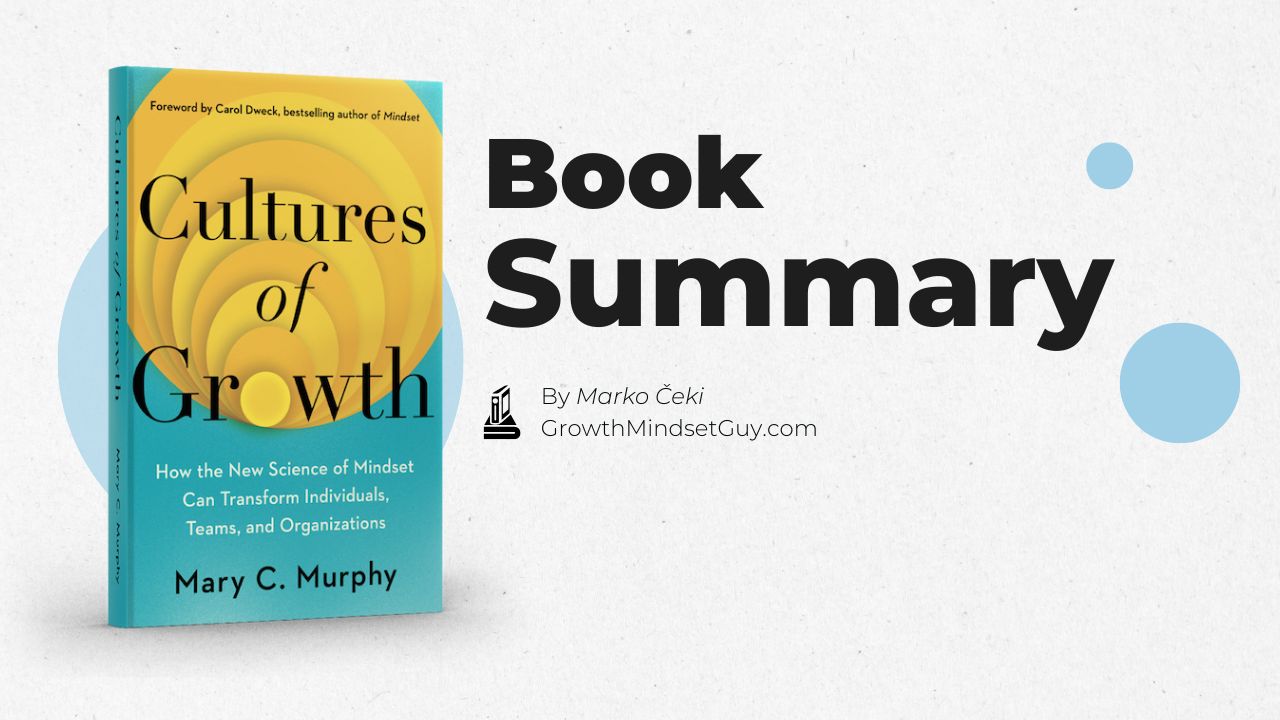
Dr. Mary C. Murphy’s book Cultures of Growth explains that mindset actually lives in the culture around you. It shows how systems, conversations, and daily habits shape the way people learn, work, and grow together.
Murphy, a social psychologist at Stanford and Indiana University and a former student of Carol Dweck, the author of Mindset, spent more than a decade studying how environments can unlock or block human potential.
Her main idea is simple:
The culture you are in often beats the mindset you have.
This article gives a clear summary of Cultures of Growth. You’ll learn its key ideas, see real-world examples, and get five practical takeaways to help you build a growth-focused culture at work or in your own life.
What Is a “Culture of Growth”?
Murphy found that teams, schools, and organizations fall into two broad mindset cultures:
- Cultures of Genius — where talent is treated as innate. People compete to look smart, hide mistakes, and fear failure.
- Cultures of Growth — where ability is seen as something that can be developed through effort, persistence, good strategies, help-seeking, and support.
In growth cultures, people are encouraged to reflect on what they learned — not just whether they hit their goals. The result is more innovation, trust, and collaboration across every level.
From Individual Mindset to Organizational Culture
Carol Dweck’s original Mindset taught that people with a growth mindset believe intelligence and skill can be developed.
Murphy takes that concept beyond individuals and applies it to systems: hiring, feedback, promotion, collaboration, and leadership.
When a company rewards “stars” and effortless performance, even the most growth-minded employee can shrink into self-protection mode.
That’s why Murphy says we don’t just have a mindset — we live inside one.
The Mindset Continuum (The Dimmer-Switch Model)
Forget the “fixed vs growth” binary. Mindset operates more like a dimmer switch than an on/off switch.
- In supportive, feedback-rich settings, your growth mindset shines.
- In perfectionist or high-stakes environments, the dimmer slides toward fixed.
The lesson: instead of judging people’s mindset, ask what cues in the culture are dimming or brightening it.
Real Examples of Growth Cultures
Murphy’s research is filled with real-world case studies showing how organizations transformed their culture — and their results:
- Microsoft (Satya Nadella): shifted from “know-it-all” to “learn-it-all,” embedding curiosity and collaboration at scale.
- Patagonia: built an authentic, purpose-driven culture where long-term learning outranks short-term wins.
- McBride Sisters Wine Company: diversified an entire industry by focusing on growth and inclusion.
- A New York school district: closed achievement gaps by teaching staff to see every student as capable of development.
- Barre3: rebuilt its company culture after realizing it had accidentally created perfectionism disguised as excellence.
Across industries, the pattern is identical: when leaders prioritize learning and psychological safety, people take smarter risks and teams perform better.
🎥 Watch: Cultures of Growth Explained
👉 (VIDEO COMING SOON!)
In this video summary, I walk through the book’s key frameworks — the “dimmer switch,” five cultural arenas, and the four mindset triggers — plus five quick actions to start building a culture of growth today.
The Five Arenas Where Culture Shows Up
Murphy identified five areas where mindset culture becomes visible:
| Arena | Culture of Genius | Culture of Growth |
|---|---|---|
| Collaboration | Compete, protect turf | Coach peers, share learnings |
| Creativity | Avoid failure | Prototype early and often |
| Risk & Resilience | Hide mistakes | Run blameless post-mortems |
| Integrity | Image over honesty | Reward transparency |
| Inclusion | Hire for pedigree | Hire for potential and perspective |
When one area improves, the others follow. Growth cultures work like an ecosystem.
The Four Mindset Triggers
Murphy uncovered four predictable situations that push people toward a fixed mindset — and how to flip them back:
- Evaluation:
Fixed: “Don’t mess this up.”
Growth: “This is feedback on strategy, not identity.” - High Effort:
Fixed: “If I were talented, this would be easy.”
Growth: “Effort builds ability.” - Critical Feedback:
Fixed: defend and explain.
Growth: decode and apply. - Others’ Success:
Fixed: “They’re ahead of me.”
Growth: “Their win is data about what’s possible.”
Spot your trigger → reframe → take one small action back toward growth.
How to Build a Culture That Compounds
A culture of growth isn’t a feel-good slogan — it’s a design challenge.
Here’s what it looks like in practice:
- Hire for trajectory, not trophies.
Swap pedigree screens for work samples and coachability. - Make learning visible.
Add 5-minute “Tried → Learned → Next” loops to weekly meetings. - Normalize drafts and post-mortems.
Early versions are expected. Mistakes get studied, not buried. - Reward collaboration structurally.
Open demos, shared docs, rotating presenters, and “Ask for Help” rounds. - Link DEI to performance, not PR.
Different perspectives make teams smarter — not just “diverse.”
When these systems align, innovation compounds. People stretch instead of protect, and trust becomes the baseline.
Top 5 Takeaways from Cultures of Growth
- Mindset is a continuum, not a label.
You shift based on cues around you. - Culture of Genius looks glamorous but kills innovation.
It rewards status over substance. - Growth cultures are demanding, not soft.
They expect continuous learning — with support. - Your systems are your culture.
What you measure and reward becomes your mindset. - Use the dimmer-switch habit daily.
When you feel fixed, pause and ask:
Which cue hit me? What’s one nudge back toward growth?
Final Thought
If you want a team — or a life — that compounds, don’t chase genius. Design growth.
In a world that still glorifies effortless talent, Cultures of Growth reminds us that the real magic happens when effort, feedback, and support become the norm — not the exception.
Related Links
- 🎥 Watch: Cultures of Growth Summary on YouTube (VIDEO COMING SOON!)
- 🧠 Related: 3 Big Lessons from Mindset by Carol Dweck
- 💡 Explore more on GrowthMindsetGuy.com